Showing posts with label denver motorcycle lawyer. Show all posts

Friday, August 27, 2010

Obtaining Medical Records after a Motorcycle Accident Personal Injury for Negotiation with the Insurance Company


After any kind of accident or injury involving either a lawsuit or insurance company, you will need copies of your medical records. Medical records help establish the facts of the case and are one of the basic metrics used to determine damages or compensation from a Denver motorcycle injury.

In our adversarial legal system, people and companies usually will not pay unless they have to, regardless of fault. So the first thing that medical records do is establish that an injury or condition was caused by the car accident. If you do not have a Denver personal injury lawyer, unscrupulous insurance adjusters may try and claim that your injuries were pre-existing. As the claimant, you do have the burden to prove your case against any attacks.

Of course you may also need to know how to access and distribute your records if your injury requires the attention of a specialist.

Outside of motorcycle injuries, medical malpractice suits usually revolve around medical records, which may mean the doctor is loath to give them up. However you do have the right to access all of your records because of a piece of legislation called the Federal Health Information Portability and Accountability Act. Generally, the act states that you have access to your own records, or someone else's if you are their representative or guardian. Executors of estates also have access to the deceased party's records. You also may ask for the records if you are related to the deceased and their disease history may shed light on your own problems.

There are a few exceptions to the records you are allowed to access. Usually these are not important for your Denver injury lawyer unless your case is related to psychotherapy or could endanger you. The law requires the medical provider to give you records within 30 days, or give a written reason for delays. Of course some state laws give patients more rights. Colorado injury patient laws are a little stricter. If you need the records and the hospital will not release them, you may need to hire a lawyer. This usually only happens when there is a pending medical malpractice lawsuit.

The doctor or hospital is allowed to charge you a reasonable fee for the records, and sometimes the records are not complete if they consist of several different specialists. You may have to file requests to each doctor to get your full medical history. It is always best to have as complete a medical history as possible before going to court as a car accident victim.

Sunday, June 20, 2010

Motorcycle-Bicycle Collisions


Both motorcycles and bicycles offer their drivers little protection in a collision. Bicycles are especially at risk at intersections for two reasons: bicyclists often ignore traffic laws at intersections, and drivers often ignore cyclists. Almost all motorcycle accidents with bikes occur at intersections, although both types of riders commonly lose control in other areas. For cyclists, the best protection from car and motorcycle accidents is to follow road rules and maximize visibility.

They must understand that intersections are exceedingly dangerous. The rules of road liability can be discussed with a Denver accident attorney, but this article aims to give a brief overview. Although cyclists have little protection, they can still be held liable for accidents if they get hit by a motorcycle while violating a traffic rule. As many Denver personal injury lawyers will attest, the actual facts and sequence of events in an accident can get skewed, and a biker who was injured by another driver who violated the law may still be blamed for the crash.

In order to keep safe from a motorcycle accident lawsuit, riders need to learn the law of liability and traffic. Motorcycles and bicycles are just harder to see. A Denver motorcycle lawyer told me a story of a motorcycle taking a left turn into a large Denver HVAC company truck. Trucks cannot see cyclists because of reduced visibility and the fact that they are simply not looking. Bikers need to keep this in mind when approaching an intersection. Keep front and rear lights on and slow down even if you have a right of way. Any rider who presumes to ride on busy streets needs to have enough command of his bike to make emergency maneuvers without losing control.

When it comes to strict liability, bikes and motorcycles are treated like any other vehicle. So liability depends on who had a right of way, or who was driving recklessly. Consider reviewing the rules of right of way at intersections with no signals, as many drivers make mistakes there. New high-tech traffic signals have sensors to detect cars at intersections. If a cyclist is not picked up by the sensor, the light may not change, so the biker or cyclist will have to wait until it is safe or cross at a crosswalk. Just be ready to explain your decision to an officer. If you do not follow these guidelines, you may have to explain your decision to the doctors at the medical center and your motorcycle lawyer


Tuesday, April 27, 2010

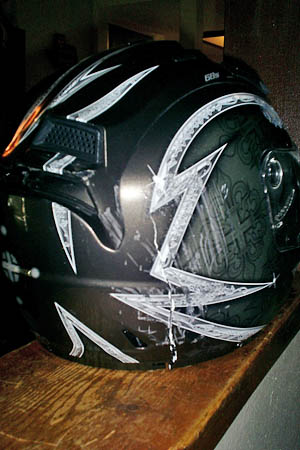
Wearing a helmet will increase your injury claim


Well, it will save your life too, but wearing a helmet can also significantly effect your ability to claim damages in a Colorado motorcycle accident. Colorado motorcycle law requires you to wear a helmet. Abiding by the law can be a key factor in deciding a Colorado motorcycle injury lawsuit. Wearing a helmet increases your chances of recovering from motorcycle neck and head injuries.

Almost half of motorcycle riders killed in accidents may have been saved if they were wearing a helmet. Helmets also significantly reduce nonfatal motorcycle injuries.

Colorado motorcycle law cares whether or not you were wearing a helmet when determining a claim. If you did not sustain head or neck injuries, the helmet is irrelevant. Your Colorado personal injury lawyer may use this information to help establish that you are a safe rider. If you weren't wearing a helmet and were lucky enough to get away without a head or neck injury, the helmet factor is once again irrelevant in Colorado motorcycle injury law.

If you were wearing a helmet and sustained head or neck injuries, your Denver motorcycle accident attorney will want to use the helmet as proof you did not get injured through your own negligence. Your motorcycle attorney will use this to show your injuries could have been much worse and you did everything to protect yourself.

If you were not wearing a helmet, and still sustained an injury from a motorcycle in Colorado, it may be hard to recover damages. Even though Colorado does not require motorcycle riders over 17 to wear a helmet, if your lack of helmet contributed to your injuries you may be comparatively negligent. This will reduce your claim based on how much the Colorado court deems you were at fault. If the insurance adjuster believes that a helmet would have reduced your injuries, then your payment will be reduced accordingly. A Denver personal injury lawyer will have to fight to stop this reduction.

In states with a requirement to wear a helmet, it will be very difficult to recover damages because your negligence in not wearing a helmet is already established. A car accident attorney might not be able to do much beyond a modest settlement.